


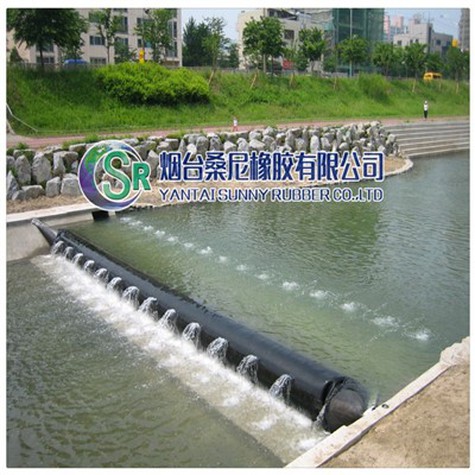
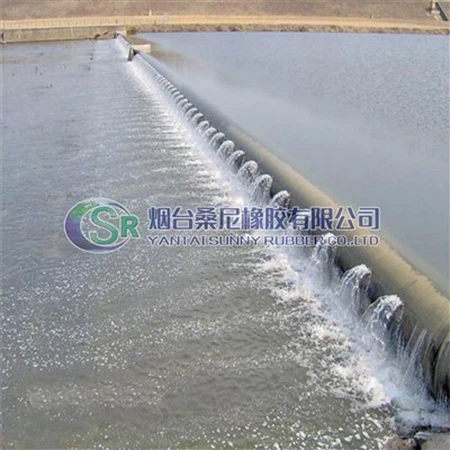
Rubber dam is a new type of hydraulic structure compared with steel sluice gate, and made of high-strength fabric adhering with rubber, which forms a rubber bag anchoring on basement floor of dam. Filling water or air into the dam bag, rubber dam is used for water retention. Emptying water or air from the dam bag, it is used for flood release. Rubber dam has many advantages compared to conventional weirs, such as low cost, simple hydraulic structure, short construction time, perfect seismic performance and effect of stopping leading, and low resistance to water flow in flood season.
Advantages of Rubber Dam
Cost-effectiveness
These are often more cost-effective than traditional concrete dams. They require less capital investment during construction and have lower maintenance costs over their lifespan. Their flexibility and ease of installation also contribute to cost savings.
Ecological Benefits
Rubber dams provide a more natural approach to water management compared to traditional concrete structures. They allow for better fish migration, preserve the natural flow of rivers, and sustain the habitats of various aquatic species.
Faster Construction
After raft construction rubber dam can be installed within 2 weeks. The installation process is very simple which doesn’t require any heavy machinery.
Environmental Friendliness
Unlike concrete dams, rubber dams have minimal environmental impact during construction and removal. They do not require extensive earthworks or dam foundations. They are eco-friendlier and more sustainable.
-
![Inflatable River Rubber Dam]() Inflatable River Rubber DamUsing air as inflated medium, eco-friendly.Short inflated and deflated time, easy to operation and management Thin profile, not block water.Automatic and manual double controlMore suitable for manyread more
Inflatable River Rubber DamUsing air as inflated medium, eco-friendly.Short inflated and deflated time, easy to operation and management Thin profile, not block water.Automatic and manual double controlMore suitable for manyread more -
![Water Inflated Rubber Dam]() Water Inflated Rubber DamProduct Information The water inflated rubber dam is a dam formed by anchoring polymer composite material on the floor according to the required size to form a closed and water-filled dam. When noread more
Water Inflated Rubber DamProduct Information The water inflated rubber dam is a dam formed by anchoring polymer composite material on the floor according to the required size to form a closed and water-filled dam. When noread more -
![Low Cost Inflatable Rubber Dam And Water-filling Rubber Dam]() Low Cost Inflatable Rubber Dam And Water-filling Rubber DamRubber dam, also known as rubber water gate, is a bag type water retaining dam formed by using high-strength synthetic fiber fabric as the stress skeleton, coating rubber inside and outside as aread more
Low Cost Inflatable Rubber Dam And Water-filling Rubber DamRubber dam, also known as rubber water gate, is a bag type water retaining dam formed by using high-strength synthetic fiber fabric as the stress skeleton, coating rubber inside and outside as aread more -
![Water Filled NR Rubber Dam]() Water Filled NR Rubber DamProduct Description Company Profile Yantai Sunny Rubber Co., Ltd established in 2005, located in Economic Development Area of Qixia City, Shandong Province. It is high-tech enterprise which shiftedread more
Water Filled NR Rubber DamProduct Description Company Profile Yantai Sunny Rubber Co., Ltd established in 2005, located in Economic Development Area of Qixia City, Shandong Province. It is high-tech enterprise which shiftedread more -
![Fin Type Inflatable Rubber Dam For Water Storage /Flood Control]() Fin Type Inflatable Rubber Dam For Water Storage /Flood C...Product Description Company Profile Yantai Sunny Rubber Co., Ltd established in 2005, located in Economic Development Area of Qixia City, Shandong Province. It is high-tech enterprise which shiftedread more
Fin Type Inflatable Rubber Dam For Water Storage /Flood C...Product Description Company Profile Yantai Sunny Rubber Co., Ltd established in 2005, located in Economic Development Area of Qixia City, Shandong Province. It is high-tech enterprise which shiftedread more -
![Water-Filled Rubber Dam With SBR/EPDM Material]() Water-Filled Rubber Dam With SBR/EPDM MaterialProduct Description Company Profile Yantai Sunny Rubber Co., Ltd established in 2005, located in Economic Development Area of Qixia City, Shandong Province. It is high-tech enterprise which shiftedread more
Water-Filled Rubber Dam With SBR/EPDM MaterialProduct Description Company Profile Yantai Sunny Rubber Co., Ltd established in 2005, located in Economic Development Area of Qixia City, Shandong Province. It is high-tech enterprise which shiftedread more -
![International Standard Inflatable Dam For Water Storage/Irrigation]() International Standard Inflatable Dam For Water Storage/I...Product Description Company Profile Yantai Sunny Rubber Co., Ltd established in 2005, located in Economic Development Area of Qixia City, Shandong Province. It is high-tech enterprise which shiftedread more
International Standard Inflatable Dam For Water Storage/I...Product Description Company Profile Yantai Sunny Rubber Co., Ltd established in 2005, located in Economic Development Area of Qixia City, Shandong Province. It is high-tech enterprise which shiftedread more -
![Inflatable Weir For River Construction]() Inflatable Weir For River ConstructionProduct Description Company Profile Yantai Sunny Rubber Co., Ltd established in 2005, located in Economic Development Area of Qixia City, Shandong Province. It is high-tech enterprise which shiftedread more
Inflatable Weir For River ConstructionProduct Description Company Profile Yantai Sunny Rubber Co., Ltd established in 2005, located in Economic Development Area of Qixia City, Shandong Province. It is high-tech enterprise which shiftedread more -
![Inflatable Weir Coated EPDM For Agriculture]() Inflatable Weir Coated EPDM For AgricultureProduct Description Company Profile Yantai Sunny Rubber Co., Ltd established in 2005, located in Economic Development Area of Qixia City, Shandong Province. It is high-tech enterprise which shiftedread more
Inflatable Weir Coated EPDM For AgricultureProduct Description Company Profile Yantai Sunny Rubber Co., Ltd established in 2005, located in Economic Development Area of Qixia City, Shandong Province. It is high-tech enterprise which shiftedread more -
![High-Quality Inflatable Dam Systems For Flood Control]() High-Quality Inflatable Dam Systems For Flood ControlProduct Description Pneumatically operated spillway gate /air bladder support gate The pneumatically operated spillway gate is a new type hydraulic structure, which can simultaneously satisfy theread more
High-Quality Inflatable Dam Systems For Flood ControlProduct Description Pneumatically operated spillway gate /air bladder support gate The pneumatically operated spillway gate is a new type hydraulic structure, which can simultaneously satisfy theread more -
![Rubber Air Dam For River Barrier & Water Regulation]() Rubber Air Dam For River Barrier & Water RegulationProduct Description Structural features: The integral rubber dam, also known as a non-overlapping rubber dam, is made of framework material (Nylon Fabric) and inner and outer covering rubberread more
Rubber Air Dam For River Barrier & Water RegulationProduct Description Structural features: The integral rubber dam, also known as a non-overlapping rubber dam, is made of framework material (Nylon Fabric) and inner and outer covering rubberread more -
![Inflatable Air Shield Dam For Landscape Water Retention]() Inflatable Air Shield Dam For Landscape Water RetentionProduct Description Structural features: The integral rubber dam, also known as a non-overlapping rubber dam, is made of framework material (Nylon Fabric) and inner and outer covering rubberread more
Inflatable Air Shield Dam For Landscape Water RetentionProduct Description Structural features: The integral rubber dam, also known as a non-overlapping rubber dam, is made of framework material (Nylon Fabric) and inner and outer covering rubberread more


Why Choose Us?
High Quality
Our products are manufactured or executed to very high standards, using the finest materials and manufacturing processes.
24h Online Service
We try and respond to all concerns within 24 hours and our teams are always at your disposal in case of any emergencies.
Quality Control
We have professional personnel to monitor the production process, inspect the products and ensure that the final product meets the required quality level standards, guidelines and specifications.
Rich Experience
Dedicated to strict quality control and attentive customer service, our experienced staff is always available to discuss your requirements and ensure complete customer satisfaction.
Types of Rubber Dam
Water-filled
In water-filled version, the regulating shaft system comprises a shaft structure with individual chambers equipped with corresponding hydraulic regulating and control devices such as flaps and gates. The regulating chamber is connected to the interior of the rubber dam via a pipe system incorporated in the weir foundation structure. Control is via a headwater probe. The weatherproof control cabinet with the electrical controls and regulating equipment is located directly at the weir or very close by.
The water-filled rubber dam system is particularly notable for delivering unrestricted regulation of the dam level. When the outflow increases, the dam height lowers continuously. When the inflow decreases again, the height is continuously raised again by the filling pump.
In winter operation, when the rubber dam is stationary and not overflowing, the fill-water can be protected against ice formation by pumping through a small amount river water with a temperature greater than 1°c.
Air-filled
The air-filled dam has a regulation apparatus consisting of a piping system leading from the inside of the rubber dam via a shaft system into the control room. The bottom of the shaft is below the level of the weir sill in order to be able to drain off the condensed water that has formed.
The operating room above houses the regulating and control equipment with fan. Control is via a headwater probe. The control cabinet with the electrical control and regulating equipment is also located in the operating room.The main advantage of the air-filled system is faster recovery after a flood event.
Under normal operating conditions, the rubber dam is inflated, and can be used to regulate the water level with continuous lowering up to 15%, after which it is usually completely deflated, but can also be operated further if the irregularity of the weir discharge does not play a role.
Materials Used in Rubber Dam
The rubber dam tube is made of strength canvas and rubber layer which ensure tightness of the rubber layers.The rubber layers encompass outer,middle and inner elements for different functions.This kind of rubber is well resistant against sharp objects,pieces of ice,stone and vibrations caused by river over flowing.The outer layer is made of the special rubber material characterized wear,sunlight,heat and ozone-resistance.The middle layer is used for protection of canvas and for connection of two or more canvas with rubber layers.The inner layer is used for protection of canvas and characterized watertight and airtight features.
Preparations
The preparatory work of inflatable rubber dam construction mainly involves two aspects, one is civil engineering; the other is the customization of inflatable rubber dam bags.
Civil Engineering
Civil engineers need to ensure the prerequisite for the construction of inflatable rubber dam, civil construction projects are mainly related to the excavation of the related control of excavating foundation ditch and burying and observation of the pipeline.
The Customization Of Dam Bag
The customization of dam bags should be more reference to several manufacturers, with carefully analysing their performance and credibility to ensure the quality of dam bags, focusing on checking whether they have the product quality certificate issued by the country and the dam bag quality inspection reports. Before making, we should strictly follow the design of the drawings for the manufacture of dam bag and its bottom gasket,it is necessary to strictly check the size and other information after leaving the factory.

Installing The Bottom Gasket
The bottom gasket must be manufactured by the factory in strict accordance with the requirements of the design drawings. Before leaving the factory, the dimensions of the gasket must be inspected in strict accordance with the design requirements. The bottom gasket should be installed before installing the inflatable rubber dam bag.
Taking Dam Bag In Place
According to the order of downstream first and upstream later, and finally the shore wall. First installing from the center line of the downstream floor to the left and right sides at the same time, after anchoring the downstream, making the dam bag tape turn to the downstream and installing the aqueduct, and then turning the tape to the upstream, aligned the anchor center line of upstream, installing from the center line of the base plate to the left and right sides at the same time. Anchoring both sides of the wall, the dam bag tape should be hung and smoothed, and anchored from the lower part.
Anchoring The Screw Platen
Anchoring the screw platen can be performed from the following procedure. First of all, pay attention to the flatness, and the head and the tail should be aligned, for where there is uneven, it should be used the rubber sheet to level up. Second, locking nuts. It should be tightened several times when locking the nuts, and carried out water experiment to ensure there is no problem, and tighten the nut again. Third, with the help of tools to ensure that the nut tightening, it is generally used torque wrench, and the bolts are tighten one by one in accordance with the stipulated torsional moment.
Installing Dam Bag
Inflatable rubber dam bag installation is the focus of the entire process of construction, before installation, it is necessary to conduct a very comprehensive inspection, the inspection items should include the base plate, backing plate and other parts of dam bag. After the inspection, it should be rinsed with water and dried before laying the base plate, and then installing the water hat. The bottom gasket and the flange gasket should be sandwiched between the inlet flange for the drain pipe and the flange of the water cap, and fixed by the bolt and screw cap. The bottom gasket shall be extended, and the anchorage place around the dam bag installation procedure shall be bored according to the bolt position and installed the anchor bolt, and then the waterproof seal shall be perforated, also be set into the anchor bolt and be laid flatly. The dam bags should transported into the warehouse and unfolded, taking the anchor foot at both ends of dam bag in place, after all the dam bag installation work is completed, the dam bag should be checked carefully before the dam bag can be closed.
Drainage Experiment
After the installation of the inflatable rubber dam bag is completed, according to the regulations, the filling and draining test needs to be carried out, so as to inspect the filling management of the dam bag and the quality of the anchor installation.
The Quality Control of Rubber Dam Construction and Installation
Arrange A Full-time Inspectors
As can be seen from the construction of the inflatable rubber dam, this important step of inspection always runs through the entire installation process. Therefore, it is necessary to arrange full-time inspectors for inspection. Check the content is not limited to the inflatable rubber dam bag, the dimensions of anchor bolt and others and the dredge situation of pipeline, etc. In the inspection, inspectors should be serious and responsible, the contents of the inspection should be carefully recorded, taking the inspection methods of sub item survey, sampling survey or comprehensive survey.
Comprehensive Inspection After Installing Dam Bag
After installing the dam bag, it is necessary to comprehensively inspect. In the absence of retaining conditions, dams should be done dam filling test; if conditions permit, the test should be carried out. The inspection items include the sealing of dam bag and the installation; the situation of embedded components; dam bag appearance observation and deformation observation; the situation of filling and drainage water (gas) facilities the observation system and the situation of pressure drop in inflatable dam bag.
Strict Construction Organization
In the construction of inflatable rubber dam, it is necessary to pay attention to the construction organization, and each process are strictly controlled through the construction organization. Inflatable rubber dam installation and construction workers should undergo the strict on-the-job training, the implementation of quality and safety control measures to further improve the quality of the project and to protect the duration of the project.
Structure and Principles
Rubber dams are hydrostatic structures provided with a bladder of textile-reinforced rubber screwed to the dam structure which creates a tight inner space.
The dam may be water-filled or air-filled. In either case a balance is created between the internal pressure of, and the water load on the bladder. By varying the filling volume the height of the bladder and thus the retention and discharge sections are adjustable to the relevant retention requirements.
The pumps and valves are controlled from a power house. The appliances required for water-filled systems are located in underground shafts and for air-filled systems in an over ground power house. Using the respective control system the retention set point is adhered to reliably. The duration of inflating and/or deflating is adjustable.
The filling medium is supplied to the rubber dam by pipes connected with the control system. As soon as the rising water level in the retention zone exceeds the retention set point, the bladder is gradually deflated until complete depletion, thus clearing the full dam opening. Vice-versa, as soon as the water level decreases the bladder is inflated. In this way the upstream water level is kept constant at the specified retention set point.
The choice of the appropriate filling medium depends on the requirements of the individual project. A number of criteria have to be considered at the planning stage.
Features of Rubber Dam
Rubber dams are variable dam barriers with a number of advantages over traditional constructions. The simple construction design with no movable parts (such as swivel joints) along with a plain shape of the concrete structure ensure low maintenance requirement of the dam. Any forces created are distributed evenly in the concrete foundation easing the reinforcement planning and the mounting on an existing dam structure. Mounting is possible on any vertical, inclined or twisted dam walls or curved or bent dam crests. What is more, due to their low construction height, rubber dams integrate harmoniously into the landscape. Repair and/or exchange of the rubber bladder is generally completed within a few days or weeks. Rubber dams are low-cost, adaptive and reliable barriers offering numerous application options.
FAQ
We're professional spillway gate manufacturers and suppliers in China, specialized in providing high quality customized products. We warmly welcome you to buy spillway gate from our factory.